
What is biofeedback?
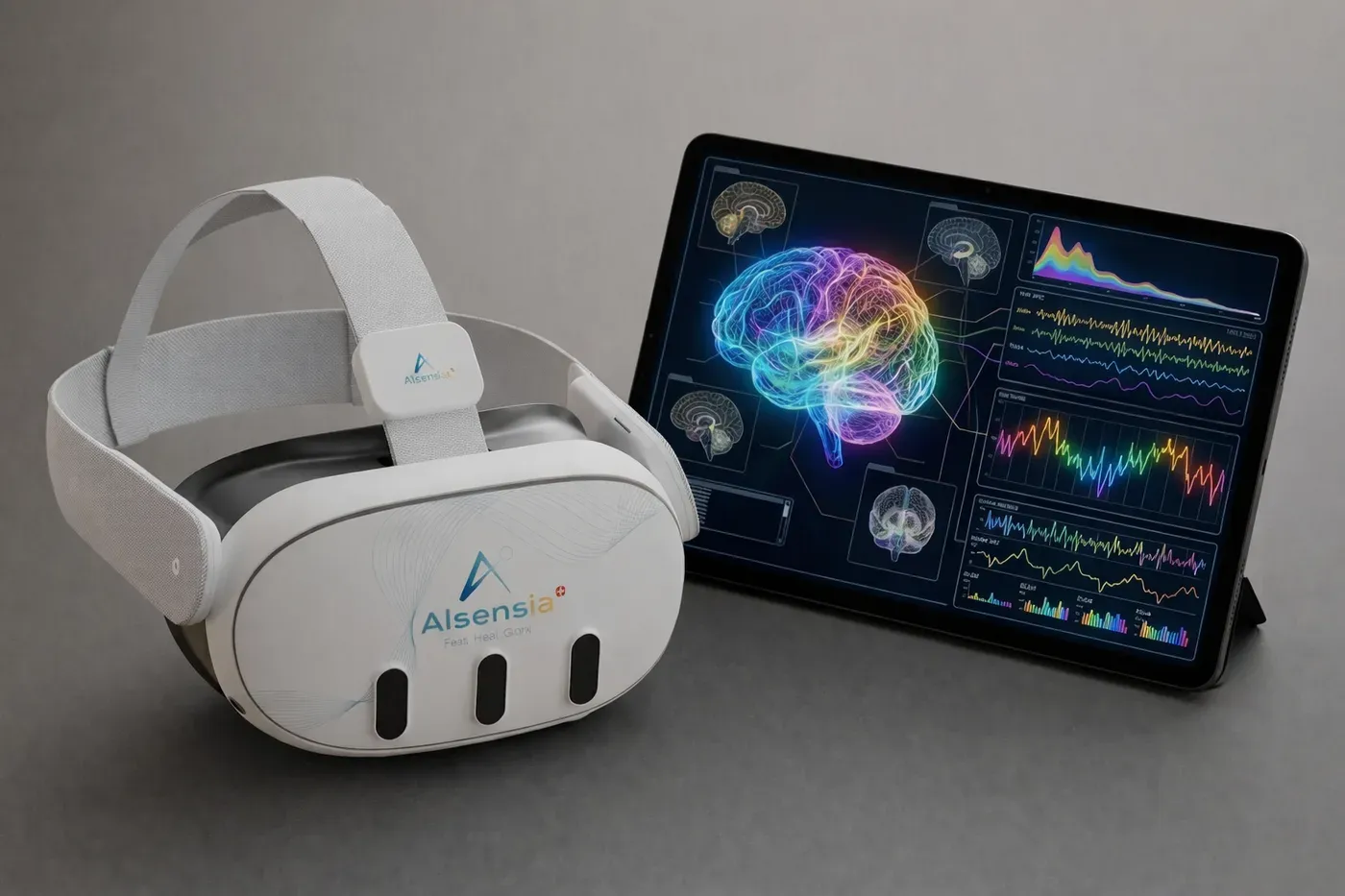
Biofeedback involves measuring physiological signals: heart rate, heart rate variability (HRV), skin conductance, muscle activity. This data is presented to the patient in visual or auditory form.
This awareness allows the patient to learn to regulate their own physiological responses.
In psychotherapy, biofeedback is used to treat anxiety, post-traumatic stress, sleep disorders and chronic pain management. Its efficacy is supported by over 40 years of research.
VR as an amplifier
Virtual reality adds an immersive dimension to biofeedback. Instead of watching a graph on a screen, the patient sees their virtual environment transform based on their physiological state.
A sky that brightens as breathing calms. A sea that settles as heart rate decreases.
This metaphorical representation makes the regulation process intuitive and engaging, even for patients who struggle with traditional relaxation approaches.
The closed loop: the heart of the system
The most advanced systems operate in a closed loop: sensors measure, algorithms interpret, the environment adapts, the patient reacts, and the cycle begins again.
Each session becomes more precise than the last, creating a truly individualised journey.
Observed outcomes
Studies show that the VR + biofeedback combination produces superior results compared to either modality used alone.
Adherence is also improved: patients report a more immersive and motivating experience, which encourages them to continue their treatment.
Integration into daily practice
For the practitioner, integration is straightforward. The system sets up in minutes, sensors are non-invasive, and the software guides the session flow.
The therapist retains full control: they choose the environment, set session objectives and can intervene at any time.
Data from each session is recorded, enabling objective tracking of patient progress over time.