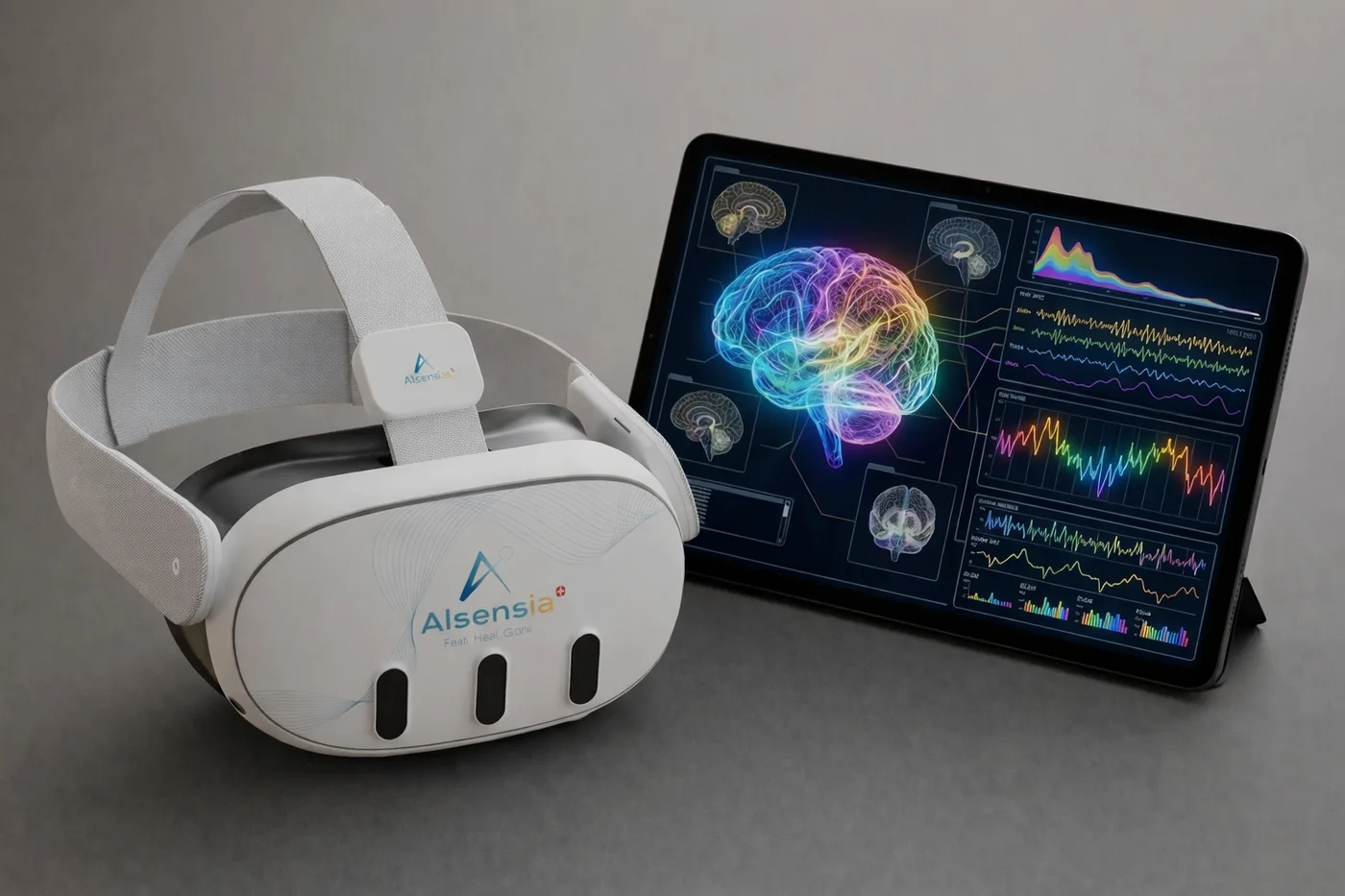
Descriptive observations reported in Alsensia’s 2026 professional information leaflet. These are exploratory findings, not evidence of clinical efficacy.
Psychiatry practice
11 sessions · observations by one clinician March–May 2026
91%
Favourable response observed in relaxation, perceived stress or mood.
82%
Positive impact on the consultation’s quality or timing.
4.8/5
Patient comfort during the session.
Working-age participants
135 participants · workplaces, events and workshops December 2025–October 2026
94%
Reported feeling relaxed.
93%
Reported mental disengagement and letting go.
4.4/5
Satisfaction.
The psychiatry figures refer to 11 sessions assessed by one clinician; they are not patient-level efficacy rates. The working-age sample is separate from the psychiatry observations. These descriptive results do not establish clinical efficacy or replace controlled evaluation.
These studies concern specific techniques and populations. They are not clinical validation of Alsensia or its programme combinations.
Breathing · Randomised study · 2023
Structured breathing and psychophysiological responses
Yilmaz Balban et al. compared brief daily breathing exercises with mindfulness meditation over one month. The study assessed mood, anxiety and physiological arousal outside a VR setting.
Across four studies, Levinson et al. examined breath counting as a behavioural measure of mindfulness and its relationship with awareness and mind wandering.
Rousseaux et al. evaluated VR, hypnosis and their combination around cardiac surgery. The trial found no significant differences between groups on the measured outcomes.
Rousseaux et al. · European Journal of Anaesthesiology
Modified states of consciousness describe experiences that differ from usual waking awareness. Research examines changes in attention, perception, bodily experience and the sense of self.
Meditation and hypnosis offer different ways of engaging attention and awareness. Virtual reality provides an immersive medium; embodiment concerns how we experience the body as our own. These approaches can interact, but they do not imply a single shared state or mechanism.
Exploratory research on cognitive-affective responses.
A 2025 peer-reviewed study involving 50 healthy participants compared two 10-minute immersive virtual reality experiences. The authors observed changes including enhanced cognitive flexibility and inhibitory control, lower state anxiety, reduced heart rate and lower sympathetic activity compared with baseline.
These findings come from research conducted by Giulia Brizzi and collaborators. They do not constitute a clinical trial of the current Alsensia product.
From immersive states to clinically relevant questions.
01
Experience design
Identify the visual, auditory and embodied parameters that shape a reproducible immersive state.
02
Measurement
Study cognitive, affective and physiological responses using validated research methods.
03
Translation
Explore how research protocols may inform future professional applications in mental health.
Research programme
PAT-VR
Psychedelic-assisted therapy research, extended through VR.
Our PAT-VR direction examines how immersive environments may support preparation, experience design and integration research around psychedelic-assisted therapy.
This is a research agenda, not a feature of the current commercial product. Any future clinical application will require appropriate validation, governance and regulatory review.
Selected publications
Work from our scientific network.
Peer-reviewed research involving members and collaborators of Alsensia’s scientific network.
2026
PRISM Project: Predictive-Processing Reshaping via Immersive Simulated Multisensory Experiences
Brizzi, Garcia-Romeu, Rocher and Riva. Cyberpsychology, Behavior, and Social Networking.
We select research-supported components and investigate their use within Alsensia protocols. Our own research evaluates effects, tolerability and safety; evidence for an individual component does not establish the efficacy of a complete protocol. Alsensia is a complementary wellbeing tool, not a medical device. Its clinical efficacy remains under evaluation.


 Breathing · Randomised study · 2023
 Mindfulness · Behavioural research · 2014
 Hypnosis & VR · Randomised trial · 2022